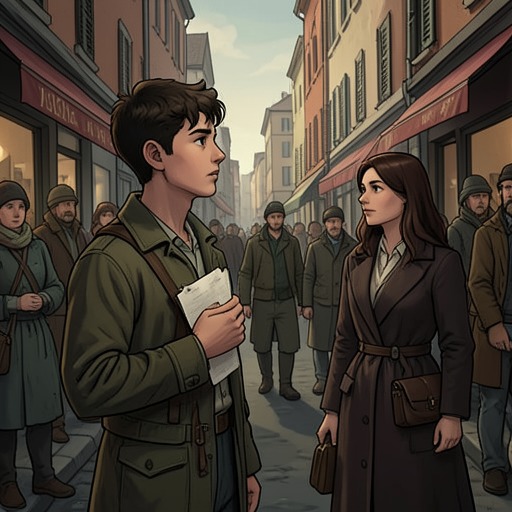
Jan
Promise at DawnJan is the narrator’s childhood rival for Valentine, a figure whose physical confidence and talent for turning competition into danger help push Romain Gary beyond the sheltered world of his home. Nearly a year older, Jan seems able to do everything Romain attempts, only better. Their rivalry begins in childhood and reappears years later at an official reception in Paris, where practiced diplomatic courtesy cannot quite contain the old hostility—or the bond created by surviving it.
Identity and Introduction
Jan first enters the story through Valentine’s account of what another boy has done to win her favor. She tells Romain that Jan ate his entire collection of sump for her; later, she says Jan ate ten spiders and stopped only when his mother called the children in for tea. These boasts establish the terms of the children’s courtship: Valentine sets the tests, and Romain tries to prove his devotion by swallowing whatever she puts before him. Jan is not present in these exchanges, but his reputation is enough to make Romain feel that love means enduring an escalating contest.
When Romain describes Jan directly, he remembers an almost-year-older boy who could match him at anything and surpass him at it. Jan had a gaunt look, a thin body, feline agility, and hard, narrow eyes. He could spit five yards with accuracy and whistle between his teeth with a stridency Romain says he never learned to equal. The remembered particulars make Jan more than a generic rival: his skill is a catalogue of small, visible humiliations against which Romain measures his own toughness.
Childhood Rivalry and Its Consequences
Romain’s affair with Valentine lasts almost a year, and he says it changes him completely. Competing with Jan and other suitors drives him to walk on his hands, steal, break windows, and fight. Jan’s advantage is not limited to the contests Valentine sets. In winter, while the boys race downhill on sleds, Romain cannot keep up with Jan standing; to answer the comparison, he jumps into the snow from a height of fifteen feet as Valentine watches and dislocates his shoulder.
Jan also gives Romain the insulting nickname “the little blue one.” Romain cannot explain why the name wounds him so deeply, but he responds by multiplying proofs of his daring. He recalls becoming a neighborhood terror, breaking windows, stealing boxes of dates and Greek halva, ringing doorbells, and pouring cold water over passers-by. The narrator connects this conduct to a larger discovery: Valentine’s attention has begun to show him that his mother’s love and the warmth of home are not what he can expect from the world at large. Jan’s rivalry therefore marks both a childhood humiliation and a harsh lesson in how affection and approval can be withheld.
The boys’ antagonism takes a still more dangerous form in their repeated window game. After a quarrel—or sometimes, Romain says, without any apparent cause—they go to the fourth floor and play without speaking. Each puts himself at the mercy of the other: a misjudged push could send one of them to his death on the stones below. Romain remembers his legs dangling over empty space, the cold metal sill beneath his bare thighs, and Jan’s hand poised at his back. The game combines enmity with a peculiar loyalty, since each boy entrusts the other with the power to kill him.
Reunion in Paris
About ten years before the narrator’s account, Romain recognizes Jan at an official reception at the Polish Embassy in Paris. Jan has changed astonishingly little: at thirty-five he still has the gaunt appearance, thin frame, feline movements, and hard, narrow eyes Romain remembers. By then Jan is an important member of the Polish Communist Party. The two men attend in their official capacities as representatives of their countries, and they treat one another with studied courtesy. Neither mentions Valentine.
Their polite exchange turns into a contest by increments. Over vodka, Jan speaks of having been tortured by the Gestapo; Romain counters that he has been wounded three times. They glare at one another, set down their glasses, and head for the stairs without a word. The conversation has brought the childhood rivalry back into the room: each man offers the dangers he has endured as a claim to standing against the other.
The Unfinished Contest
Jan opens a second-floor window and bows politely, since Romain is his guest at the embassy. Romain already has one leg over the sill when the ambassador’s wife emerges from a reception room. He withdraws his leg, bows with a pleasant smile, and lets her take both men by the arm and lead them to the buffet. Her intervention prevents the old game from ending in a fall, but the scene leaves the contest unresolved rather than settled.
The narrator imagines the public scandal if, at the height of the Cold War, an important Polish Communist or a French diplomat had been found on the pavement after being thrown from an upper window of the embassy. The thought turns private childhood danger into a possible international embarrassment. Jan’s return thus reveals the persistence of a rivalry beneath adult roles: official courtesy can defer the contest, but a glance, a boast, and a staircase are enough to bring it back.